Semrush: Dash or pipe in your title tag?
What?
For a large e-commerce company in Australia, we investigated whether replacing pipes (|) with dashes (-) in category page title tags would influence organic performance. What initially seemed like a purely stylistic adjustment turned out to be a small but strategically relevant change with measurable impact.
Title tags are one of the most critical on-page SEO elements. They not only help search engines understand the content of a page but also determine how attractive that result appears to users in the SERP. Still, the exact effect of punctuation within titles is often overlooked. This test aimed to answer a simple question: Can a minor formatting tweak improve CTR and organic traffic?
How
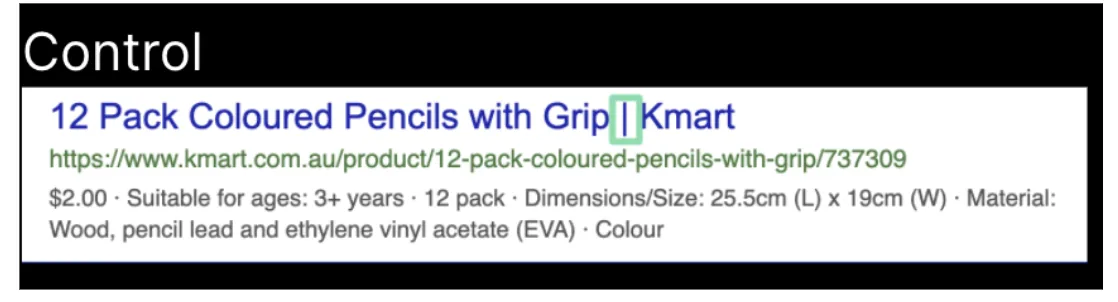
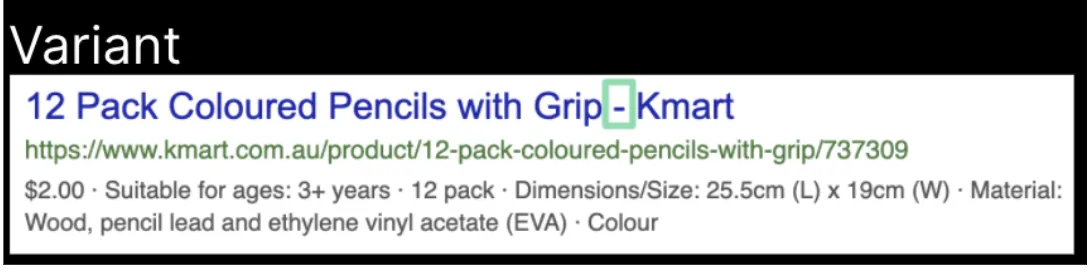
Using Semrush SplitSignal, we conducted a controlled A/B test. In the variant group, we replaced all pipes (|) in title tags with dashes (-) across 400 category pages. The control group retained the original titles using pipes.
The reasoning behind this test was twofold.
First, there’s a technical component: Google measures title tags in pixels, not characters. A pipe symbol occupies slightly more space than a dash, meaning that a title with dashes can sometimes display an additional word or two in the visible SERP snippet, often enough to show a brand name or key phrase in full.
Second, there’s a psychological element. Dashes create a smoother reading flow, whereas pipes act as visual separators. We wanted to test whether this subtle visual difference influenced user perception and therefore, click behavior.
Over a 21-day test period, we tracked impressions, clicks, and CTR across both groups. With SplitSignal’s controlled setup, we could isolate the variable and exclude external factors like seasonality or ranking shifts.
Result
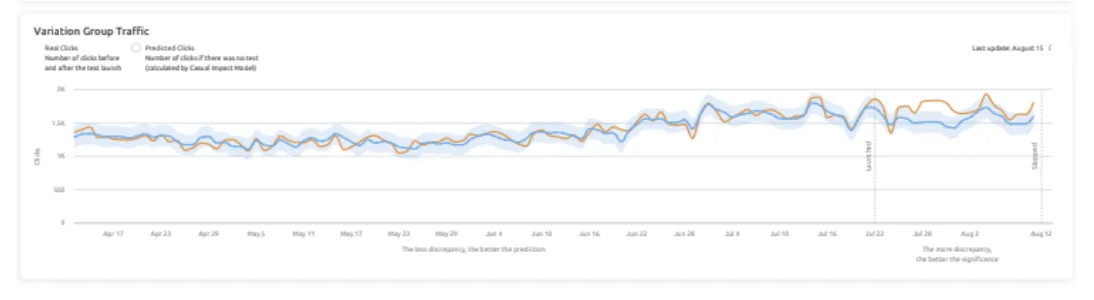
The results were clear. After 21 days, the variant group using dashes achieved a 9% increase in organic clicks compared to the control group using pipes. This improvement was statistically significant and consistent throughout the test period.
Importantly, there was no major change in impressions or rankings. This suggests that the gain came not from higher positions but from improved readability and appeal of the title in search results. The change influenced user behavior, not the algorithm.
In SplitSignal’s data visualization, the orange line (test group) consistently outperformed the blue line (control prediction), confirming a real, positive impact.
A small punctuation change led to a measurable uplift in user engagement, a reminder that micro-optimizations in SEO can deliver surprisingly large results.
A small change, a big difference in clicks.
This test highlights the importance of continuous experimentation with SEO elements that are often taken for granted. Page titles may seem fixed, but every detail — from word order to punctuation — affects how users interpret and respond to a result.
For this e-commerce brand, the adjustment drove higher engagement without any negative side effects or ranking volatility. The next step is to apply this insight across other page types, such as brand and product pages, and to test the effect in other languages and markets.
Even minor visual changes can resonate differently with users across regions. Testing allows brands to move from assumption to evidence — and to use data, not intuition, to make optimization decisions.
A/B testing is no longer optional for SEO. It’s the most reliable way to prove what works, prioritize high-impact changes, and continuously improve performance.